A study-style management framework
TCB™
THECORPORATE BODY
Stop forcing people into a bell curve. Reward departments for their real contribution to your products, the way the human body feeds its organs according to what it is doing.
By Abdullah Alzamil · Revised Professional Edition 2026
The problem
When the curve becomes more important than the truth
In a team of ten, a forced distribution allows one top rating, two fours, six threes, and someone must land at the bottom even if nobody underperformed. The manager stops evaluating performance and starts fitting people into a pre-decided shape.
8 of 10 people rated below what they actually delivered.
“This is not performance management. This is performance allocation.”
The idea
A company is a body
The body doesn’t feed its organs by size or by a quota. It feeds them according to what it is doing: running, digesting, healing. TCB™ applies that discipline to variable reward, and adds the governance biology gets for free.
An interdependent living system, not a machine.
Each has a specialised role and its own measure of success.
Each lifecycle stage draws on a different mix of organs.
A finite pool, allocated to healthy contribution.
Signals of performance and of health.
Size is not importance
The brain is about 2% of body weight but uses about 20% of resting energy. Companies are full of brains: small teams with outsized consequence that a bell curve tends to overlook.
Evidence, not anatomy
The metaphor explains roles. Weights come from the Dynamic Contribution Matrix and its evidence.
Weights follow the lifecycle
Sales leads acquisition; operations, service and protection lead retention.
Set before the period
Funding, weights, ceilings and gates are approved and published in advance.
Health Gates
Results built on burnout, customer harm or hidden risk are reduced, or stopped at zero.
A testable experiment
Simulate, run a shadow pilot, and only then touch real pay.
The reward formula
One formula anyone can follow
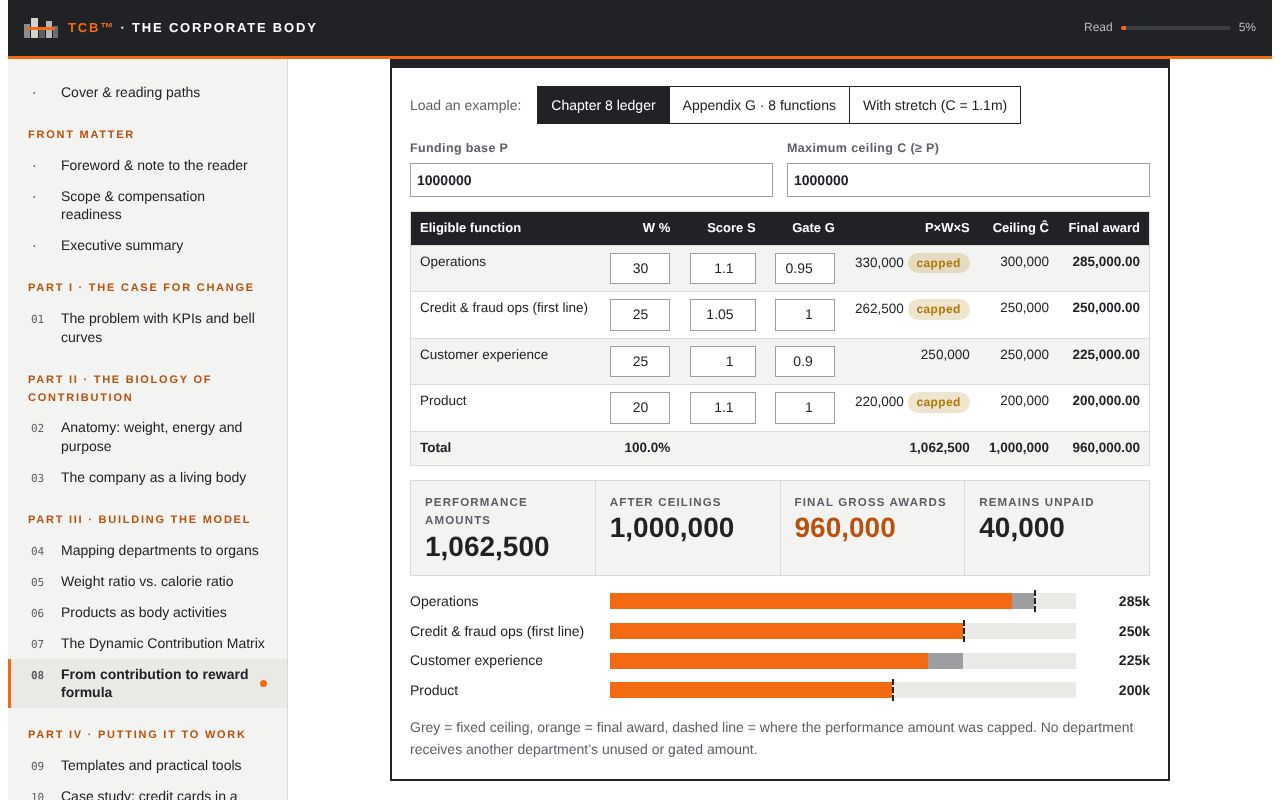
Performance amount, capped at the department’s own ceiling, then its own Health Gate, then rounded down. What isn’t earned stays unpaid. It never moves to another department.
Try it with the book’s Operations example. Move any slider.
Videos
The full walkthrough
Ten minutes covering all five parts of the book, from the case for change to how to prove the model works. Jump to any part.
Narrated in English with on-screen captions.
Interactive edition
Read it. Then work it.
Every chapter with the book’s figures, a check-your-understanding quiz for each one, and fourteen working tools loaded with the book’s own examples.
- Reward calculator
- Weight-setting workbench
- Health Gate register
- Individual allocation, to the cent
- Credit-card case, years 1–3
- Compensation readiness gate
The interactive edition is in English.
For organisations
Pilot TCB™ in your organisation
TCB™ is offered as an experiment, and the safest way to test it is a structured 90-day simulation and shadow pilot on one product, with no change to anyone’s pay.
Frame
Choose one product, name its lifecycle stage and outcomes, and set up the committee, conflict rules and review owners.
Build
Run the weight-setting protocol, grade the data, define KPIs and Health Gates, and simulate on historical results.
Shadow
Run alongside your current system, reproduce every calculation independently, gather feedback, and decide the next step.
No deadline for live pay. Real pay is considered only after legal, HR, pay-equity, payroll, privacy, risk and audit reviews have all passed.
Request a pilot conversation

The complete book
Get the full book, free
The full framework, the credit-card case study, every template, and the implementation decision rules. Leave your details and the PDF downloads straight away.
Questions
Frequently asked
Isn’t a finite reward pool just another bell curve?
No. The pool limits funding, not the distribution of ratings. Every department can meet or exceed its target; each is capped only at its own pre-approved ceiling, and unearned amounts simply stay unpaid.
Does the body analogy decide who gets paid more?
No. The analogy explains roles. Weights come from an evidence-based protocol that scores each department’s causal influence, accountability, execution and criticality for a specific product and stage, approved before the period.
Could this become a disguised way to cut staff?
That is exactly what Health Gates are for. Results achieved through burnout, errors, customer harm, hidden risk or compliance breaches reduce the reward or stop it at zero.
How are independent risk, compliance and audit treated?
They stay outside the business product pool and are rewarded through a separately funded and independently governed route, so the business they oversee never decides their pay.
Can weights change in the middle of the year?
Ordinary changes take effect next period. Only a defined exceptional event can trigger a mid-cycle change, with non-conflicted approval, a new version and a prospective effective date. It is never used to reduce pay already earned.
Is TCB™ proven?
It is presented as a study-style hypothesis. The book sets out six hypotheses, a staged evaluation from simulation to shadow to real pay, and the results that would disprove the model.
Contact
Start the conversation
For executive briefings, speaking, pilots or coaching, write to Abdullah directly.